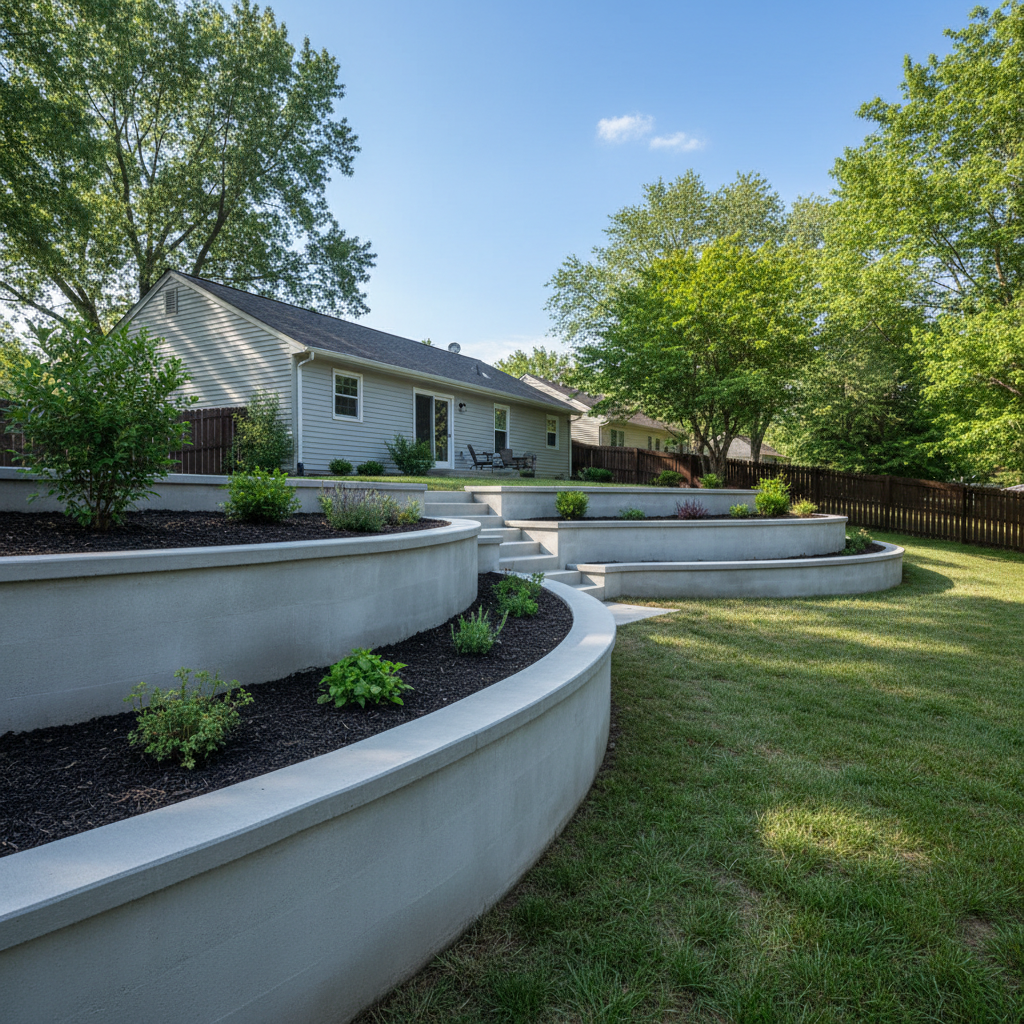
Alright, let's talk about retaining walls. Concrete ones, specifically. You're probably thinking about one because your yard has a slope, maybe some drainage issues, or you just want to create some usable flat space. Good idea, when it's done right. But man, I've seen some real headaches come from these projects when folks don't know what they're doing or who they're hiring. As a guy who's been pouring concrete in Kansas City for years, I've got a pretty good handle on the common screw-ups. Let's get into them so you don't end up regretting your investment.
Mistake #1: Ignoring the Soil and Drainage
This is probably the biggest one, and it's where most DIYers or cheap contractors really fall flat. You can't just plop a wall down and expect it to hold back tons of soil, especially not with the clay we've got around here. Our Kansas City soil, particularly that heavy, expansive clay, holds water like crazy. If that water builds up behind your wall and has nowhere to go, it's going to create immense pressure. We're talking thousands of pounds per square foot. That's how walls crack, bulge, lean, and eventually fail, plain and simple.
You absolutely need a proper drainage system behind that wall. That means gravel backfill, perforated pipes (weep holes), and an outlet for the water to escape. If your contractor isn't talking about drainage, run. Seriously. It's non-negotiable. I've seen walls that looked great for a year, then after a heavy spring rain, they're leaning like the Tower of Pisa. Don't let that be your wall.
Mistake #2: Skimping on the Foundation
A retaining wall is only as strong as its base. Think about it: it's holding back a lot of weight. If the foundation isn't deep enough, wide enough, or properly reinforced, the whole thing is going to shift. Here in KC, we get some serious freeze-thaw cycles. Water gets into the ground, freezes, expands, and pushes things around. If your foundation isn't below the frost line (which is typically 30-36 inches deep around here), that wall is going to heave and settle unevenly. You'll see cracks, and it won't be long before you're looking at a complete rebuild.
A good concrete retaining wall needs a solid, reinforced concrete footing. It's got to be wide enough to distribute the load and deep enough to resist frost heave. If a contractor tries to tell you they can just put it on a shallow gravel base, or worse, directly on the dirt, that's a huge red flag. They're cutting corners, and you'll pay for it later.
Mistake #3: Not Getting Permits or Engineering Plans
I know, I know, permits are a pain. But for a retaining wall over a certain height (usually around 4 feet, but check with your specific city or county planning department in the KC metro), you're going to need one. And you'll likely need an engineer to design it. Why? Because these aren't just decorative garden borders. They're structural elements that can fail catastrophically if not designed correctly.
An engineer will consider your specific soil conditions, the wall's height, the load it needs to hold, and then design the proper foundation, reinforcement (rebar), and drainage. Trying to skip this step is not only illegal in many cases, but it's incredibly risky. If your wall fails and damages property, or worse, injures someone, you're on the hook. A reputable contractor, like us at Precision Concrete, will always insist on proper permits and engineering for significant retaining wall projects. If they don't bring it up, that's another big red flag.
Mistake #4: Choosing the Wrong Contractor (or the Cheapest One)
This is a classic. You get three bids, and one is significantly lower than the others. Your first thought might be,