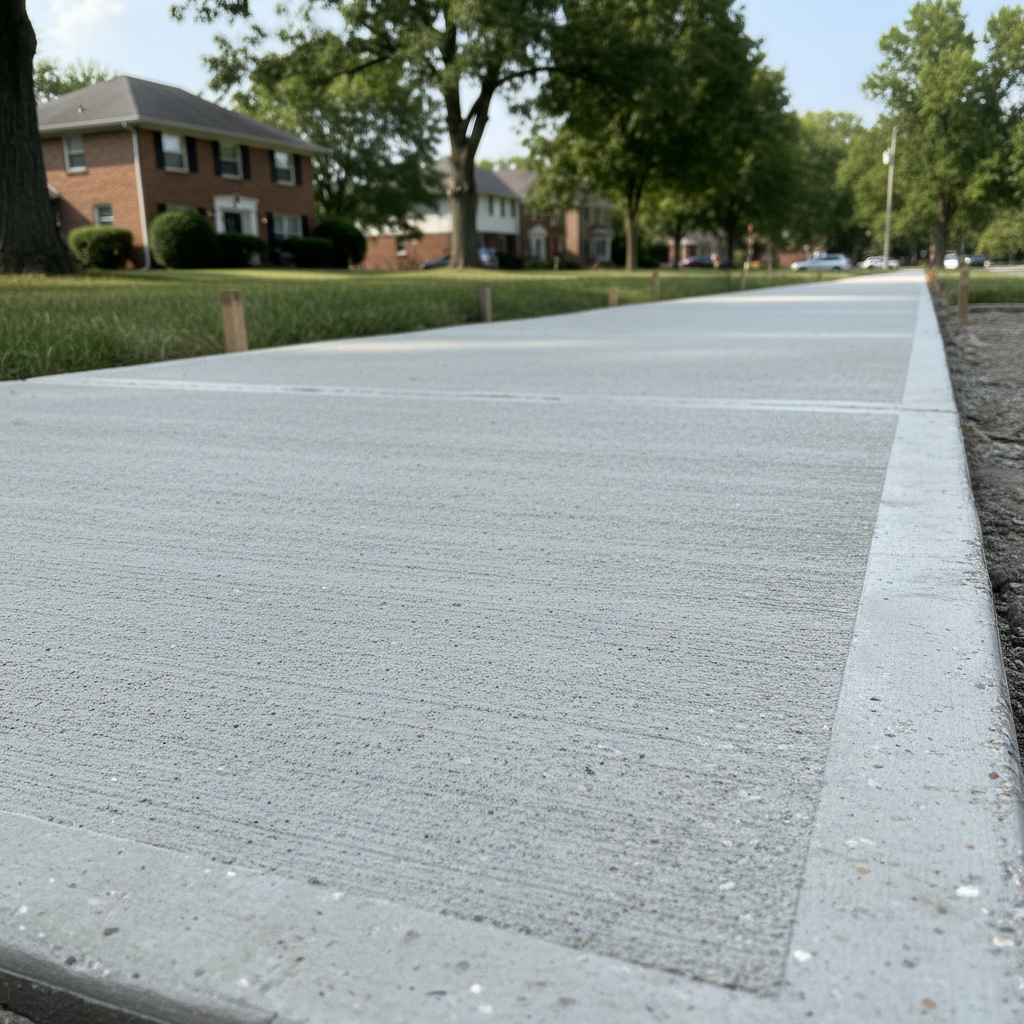
Running a crew out here means Precision Concrete gets asked a lot of questions about flatwork, and concrete sidewalks come up constantly in Kansas City, MO. Homeowners want to know what to expect, how to keep things from cracking, and what the whole process looks like from start to finish. Precision Concrete spends a good chunk of our season putting in new concrete sidewalks or tearing out old ones that have heaved. Here are the straightforward answers to the most common questions our team hears on job sites across Waldo, Overland Park, and out toward Independence.
How long before I can walk on a new sidewalk?
You can usually walk on fresh concrete sidewalks after about 24 to 48 hours, depending on how hot or humid it is outside. Just because you can walk on it does not mean it is fully cured, though. Concrete hardens through a chemical process, not by drying out. While concrete sidewalks gain most of their strength in the first week, the material keeps getting harder for nearly a month. Keep pets, kids, and heavy foot traffic off your concrete sidewalks for at least a couple of days, and hold off on rolling heavy equipment or wheelbarrows across the surface for a full week.
Why do concrete sidewalks crack so easily in Kansas City?
Local weather and soil conditions are brutal on flatwork. We deal with heavy clay soils that swell up when they get soaked in the spring and shrink right down when they dry out in July and August. Add in our freezing winters where the ground goes through dozens of freeze-thaw cycles, and your concrete sidewalks are constantly moving. If the sub-base was not prepped right or the contractor skipped cutting control joints, that shifting ground is going to snap the concrete sidewalks wherever it feels like it.
Do I need a permit to replace my front walkway?
If your concrete sidewalk is entirely on your private property, you generally do not need a municipal permit for a standard replacement. However, if your walkway connects to the public city sidewalk or crosses into the municipal right-of-way near the street, the rules change fast. Cities like Kansas City, MO have strict codes about grade, ADA slopes, and who is responsible if someone trips. Always check local guidelines if your project touches public property, because you do not want a code enforcement officer making you tear out a brand-new pour.
Can you pour over my old, cracked sidewalk to save money?
Precision Concrete gets asked this all the time, and the short answer is no, our team will not do it. Pouring a thin layer of new concrete over a broken-up old slab is a recipe for disaster. The cracks underneath will quickly telegraph right through the new layer, and the whole concrete sidewalk will delaminate within a single winter. If you want concrete sidewalks to last, the old material has to come out, the sub-base needs to be re-compacted, and a fresh, properly thick slab needs to go down.
How thick should a residential sidewalk be?
For standard foot traffic, concrete sidewalks should be poured at a minimum of four inches thick. If you have an area where a lawnmower or a small utility vehicle might occasionally cross over the path, or if you live in an area with particularly nasty clay expansion, bumping that up to five or six inches with wire mesh or fiber reinforcement is a smart move. Skimping on thickness to save a few bucks on concrete yards always catches up to you later.
What causes the surface to pit or flake off?
That flaking or peeling is called scaling, and it usually happens because of water getting trapped in the concrete sidewalks during their first winter, or from using harsh ice-melt chemicals too early. If you pour late in the fall when the temperatures drop too fast, the surface can freeze before it properly cures. Also, stay away from rock salt or de-icers during the first winter on new concrete sidewalks. Use plain sand or kitty litter for traction instead, and save your concrete sidewalks from premature aging.